The 5 Stages of Edit Letter Grief

It’s an exciting time in a writer’s life! You’ve taken your book as far as you can get it by yourself and you send it off to your CP/Agent/Editor and they turn around and give you an edit letter detailing the good, the bad, and the ugly about your manuscript and lots of notes on what needs work.

It’s like standing at basecamp on an enormous mountain, looking out on the beauty around and marveling at how high up you are… You take a deep breath and while you’re filling your lungs with all that delicious oxygen, your guide sneaks around and gut punches you then points to the top of the mountain and yells, KEEP CLIMBING!

Getting an edit letter—be it your first or one thousandth—you’re bound to go through at least a few of the stages below.

  1. Denial. My editor has NO idea who my characters are, has no concept of the heart of the story and is ABSOLUTELY wrong! These are NOT the changes that need to happen in this story!
  2. Anger. Well crap, my editor is right. The book really does need these changes, BUT THEY ARE IMPOSSIBLE! How in the world can she even ask me to do them? Her notes were too vague. She’s basically setting me up to fail!
  3. Bargaining. Okay, I can see how to do a few of the notes, but the others? No idea! What about  I change these few things, then I bet it won’t be necessary to do the rest of your suggestions… okay? Not enough? What can I give you to just lie and say it’s ready?
  4. Depression. I’m finally vibing with all these suggested edits, my editor was totally right. Why didn’t I think of these changes in the first place? It’s because I’m a TERRIBLE writer with no imagination! My editor should just finish this manuscript because she obviously knows better than I do. I suck. I suck. I suck.
  5. Acceptance. I just fell in love with my manuscript all over again after finishing these edits. I love writing! I love my editor! I love edit letters!

Any of this sound familiar? Oh it sure does to me because I’ve been there… many times!

A tip for working through these stages as quickly as possible? When you get your letter, let the notes sit for awhile before you start trying to make it work. If you sit down and try to start implementing before they’ve had time to marinate a bit, you’re going to get stuck in one of the first four stages and it will take you longer to move on to stage 5…

If you’re wondering how I tackle edit letters, check out these blog posts.

5 Stages of edit letter grief-2

Does #PitchWars Increase Your Chances of Signing with an Agent?

If you’ve been reading my blog for any length of time, you know I’m a huge fan of Brenda Drake’s #PitchWars!

I was in #PitchWars in 2014, received about 7 agent requests for my manuscript, and one of those requests later turned into an offer of representation!

The majority of the #PitchWars2014 class are still in contact thanks to a not-so SUPER-SECRET Facebook page, and although I can’t attest to the entire #PitchWars class (there were over a 100), I do have stats for the 85 mentees who participate in our group.

So, does being in #PitchWars increase your chances of getting an agent offer? I would say, YES! Out of the 85 mentees who participate in the Facebook group, 50 are agented and of those, 18 have book deals.

BONUS FOR INQUIRING MINDS: I would say the majority of those offers happened between January and July of 2015, but mostly toward the beginning of the year. For example, I was the 18th one in the group to receive an agent offer and I received my first offer at the beginning of February.

But HOW #PitchWars helps you get an agent may not be the way you think.

I did a poll of the 2014 mentees and 49 people responded…

blog data

Out of the 36 people who responded that are now agented, only 5 of those offers happened because the agent requested via the #PitchWars agent showcase.

So, the numbers don’t lie. It is VERY clear that #PitchWars does indeed help you get an agent, but not necessarily because agents are going to see your work at the showcase. #PitchWars helps you get an agent because it’s one of the only contests that focuses on craft over connections.

@destinywrites

In #PitchWars, you’re working with mentors who have been around the writing block a time or two and are committed to seeing your manuscript become the very best it can be. They are committed to helping you fill in the plot holes, tighten up your dialogue, and make your manuscript and query so polished that when you start querying (which you will RIGHT away, trust me), you’ll start getting requests. Then when other agents read, they get all grabby hands with your book.

giphy

Not only that, but working with a mentor also teaches you how to edit with an edit letter, hone your query, develop a pitch, and also exposes you to other writers. And finding your writing community is the only thing that’s going to get you through this crazy journey.

If you’re a writer of any genre who is looking for that extra edge before they start querying, give #PitchWars a try! You can find out all the info HERE.

And I’m so excited to be a #PitchWars mentor this year with Lynnette Labelle for you YA authors out there!

Writing Routines…

So I’ve been thinking a lot about writing routines and how I can implement them in my own life.

I’m busy… I’m pretty sure I’ve mentioned that a time or two thousand times. But I also could do better with time management. Discipline is always something that I strive for, but tend to burn myself out on trying to be too strict. However, I’ve discovered that I need more time to write than what I have right now and the only way to find that time is to make the time.

I recently enrolled in Jessica Brody’s time management course for writers and I think the most significant thing I got out of it (besides a nifty word count tracker spreadsheet that ignites my competitive spirit) is the fact that I need to establish a writing routine.

For me, it’s not something I should do, but rather must do. If I’m going to be an actual legit writer who writes at least a book a year—while maintaining a full-time job, family, and social life—than I must establish a writing routine or I’ll fall flat on my face.

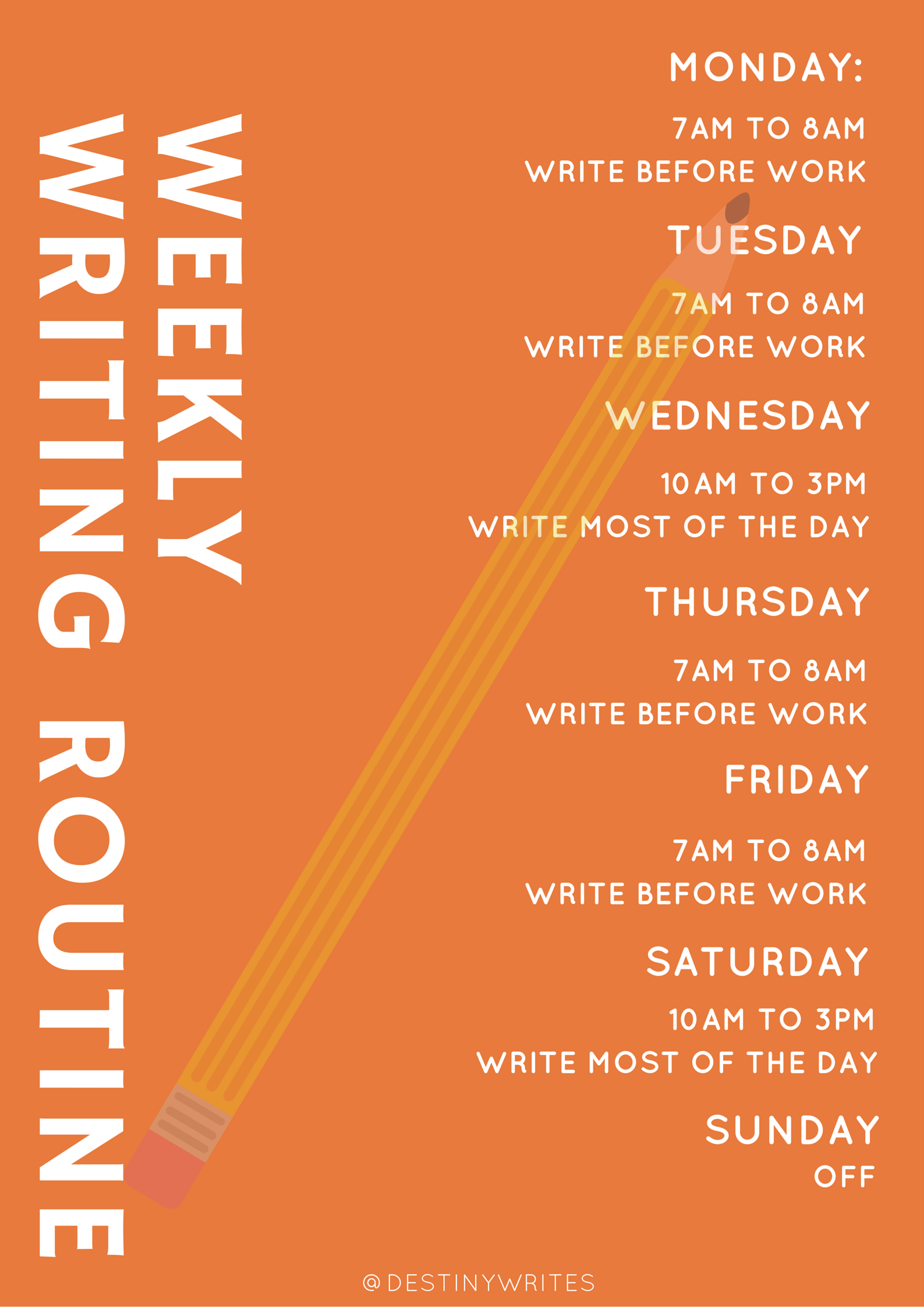
Jessica is big on the writing routine, even if it’s for short periods of time, which is good because it’s all I can give at the present. I’m thinking if I could just get in one dedicated hour in the morning before all the hassle of my day begins (and before I check work email or social media), then I can still write at night like I currently do, but it will be bonus words versus my only words.

So here’s what I’m thinking…

weekly writing routine

I won’t get in to all the tips Jessica gives (because you can just sign up for her class and get them all yourself… It’s super cheap!) but I really loved getting an insight into a successful author’s routine. I’m also interested to find out other writer’s routines. I’m going to be asking around, so I’ll post a follow up to this blog with some helpful tips! I’d also love to hear from you in the comments!

Is There A “Writer Type”?

Sometimes I think I have a weird personality for a writer.

I’m not emotional enough.

Not artistic enough.

Not introverted enough.

Instead, I’m a Type-A personality. Driven. Focused. Blunt. Organized. Business minded.

I set goals quarterly and focus on the future and have professional goals outside of publishing.

Because of this, people often discount the creative in me. They are surprised that I write. They are surprised that I struggle with depression. They are surprised that I feel things on so many levels at the same time. Surprised that I internalize my emotions.

“Oh, I wouldn’t have guessed that about you,” is something I hear often.

And it’s been that way my entire life.

I used to think that writing was just what everyone’s go-to outlet was. That it was normal that I obsessively wrote in my journals as a teen. That it was normal I penned poems on scraps of paper and then threw them away in between class. That everyone needed to write out their emotions in some weird poem or story to understand what exactly they were feeling.

But I wasn’t a writer.

I was going to be a lawyer. A businesswoman. A politician.

I wasn’t creative enough to write.

And so that’s what I believed for years and years.

Until I grew so tired of telling myself I wasn’t a writer that it forced me to realize that being a writer was all I ever was.

So maybe I’m not the classic “writer type.”

Maybe I’m not traditionally creative and maybe marketing comes easier than beautiful prose.

But I’m still a writer.

I write to explore the world around me.

I write as an answer to the stereotypes that push against me.

I write to discover who I am outside of labels and categories and expectations and fears.

I write because that’s how I answer my own questions about faith and love and forgiveness and pain and bigotry and motherhood and so much more.

I write for me. I write for you.

I write.

write