Does #PitchWars Increase Your Chances of Signing with an Agent?

If you’ve been reading my blog for any length of time, you know I’m a huge fan of Brenda Drake’s #PitchWars!

I was in #PitchWars in 2014, received about 7 agent requests for my manuscript, and one of those requests later turned into an offer of representation!

The majority of the #PitchWars2014 class are still in contact thanks to a not-so SUPER-SECRET Facebook page, and although I can’t attest to the entire #PitchWars class (there were over a 100), I do have stats for the 85 mentees who participate in our group.

So, does being in #PitchWars increase your chances of getting an agent offer? I would say, YES! Out of the 85 mentees who participate in the Facebook group, 50 are agented and of those, 18 have book deals.

BONUS FOR INQUIRING MINDS: I would say the majority of those offers happened between January and July of 2015, but mostly toward the beginning of the year. For example, I was the 18th one in the group to receive an agent offer and I received my first offer at the beginning of February.

But HOW #PitchWars helps you get an agent may not be the way you think.

I did a poll of the 2014 mentees and 49 people responded…

blog data

Out of the 36 people who responded that are now agented, only 5 of those offers happened because the agent requested via the #PitchWars agent showcase.

So, the numbers don’t lie. It is VERY clear that #PitchWars does indeed help you get an agent, but not necessarily because agents are going to see your work at the showcase. #PitchWars helps you get an agent because it’s one of the only contests that focuses on craft over connections.

@destinywrites

In #PitchWars, you’re working with mentors who have been around the writing block a time or two and are committed to seeing your manuscript become the very best it can be. They are committed to helping you fill in the plot holes, tighten up your dialogue, and make your manuscript and query so polished that when you start querying (which you will RIGHT away, trust me), you’ll start getting requests. Then when other agents read, they get all grabby hands with your book.

giphy

Not only that, but working with a mentor also teaches you how to edit with an edit letter, hone your query, develop a pitch, and also exposes you to other writers. And finding your writing community is the only thing that’s going to get you through this crazy journey.

If you’re a writer of any genre who is looking for that extra edge before they start querying, give #PitchWars a try! You can find out all the info HERE.

And I’m so excited to be a #PitchWars mentor this year with Lynnette Labelle for you YA authors out there!
Writing Routines…

So I’ve been thinking a lot about writing routines and how I can implement them in my own life.

I’m busy… I’m pretty sure I’ve mentioned that a time or two thousand times. But I also could do better with time management. Discipline is always something that I strive for, but tend to burn myself out on trying to be too strict. However, I’ve discovered that I need more time to write than what I have right now and the only way to find that time is to make the time.

I recently enrolled in Jessica Brody’s time management course for writers and I think the most significant thing I got out of it (besides a nifty word count tracker spreadsheet that ignites my competitive spirit) is the fact that I need to establish a writing routine.

For me, it’s not something I should do, but rather must do. If I’m going to be an actual legit writer who writes at least a book a year—while maintaining a full-time job, family, and social life—than I must establish a writing routine or I’ll fall flat on my face.

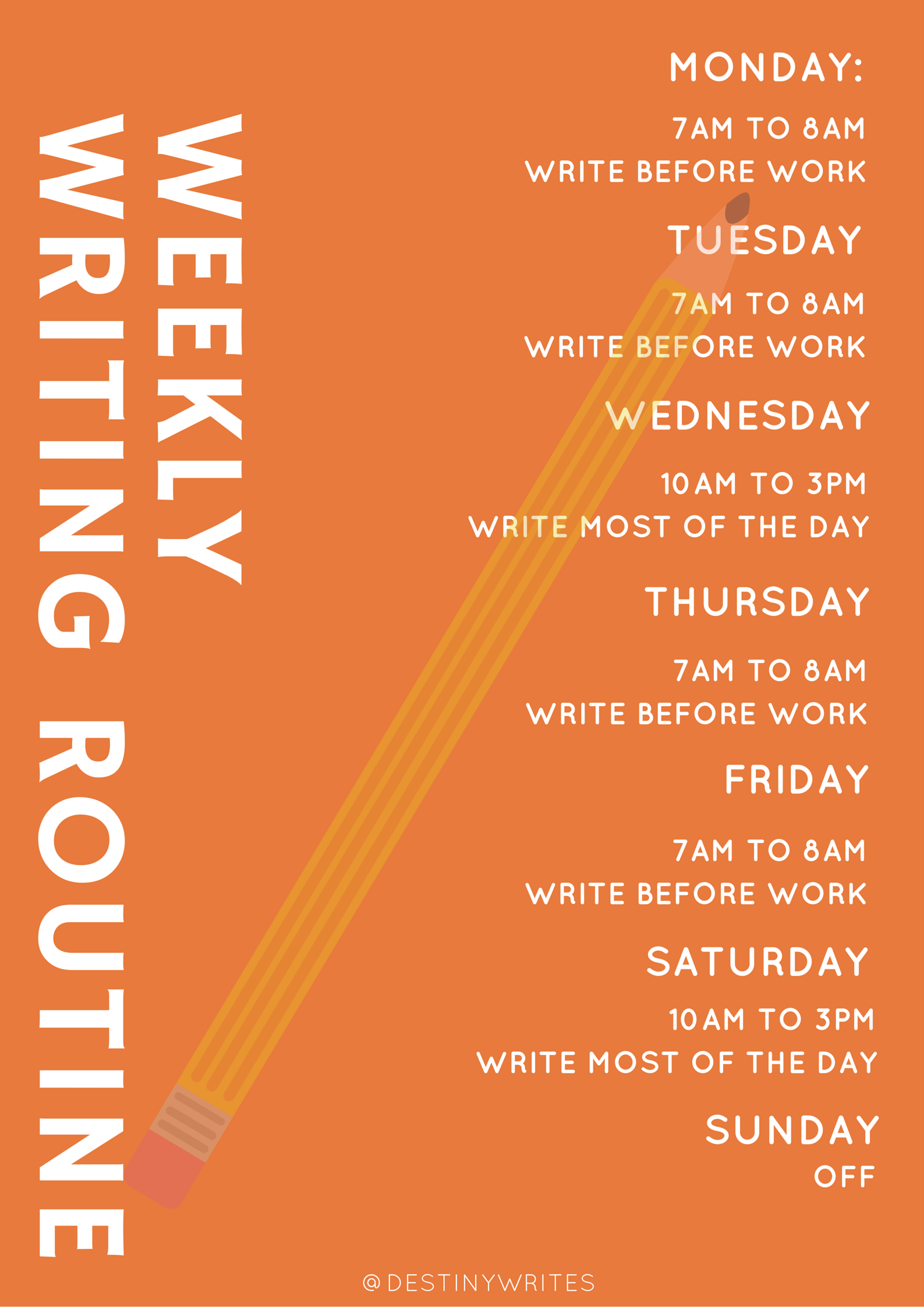
Jessica is big on the writing routine, even if it’s for short periods of time, which is good because it’s all I can give at the present. I’m thinking if I could just get in one dedicated hour in the morning before all the hassle of my day begins (and before I check work email or social media), then I can still write at night like I currently do, but it will be bonus words versus my only words.

So here’s what I’m thinking…

weekly writing routine

I won’t get in to all the tips Jessica gives (because you can just sign up for her class and get them all yourself… It’s super cheap!) but I really loved getting an insight into a successful author’s routine. I’m also interested to find out other writer’s routines. I’m going to be asking around, so I’ll post a follow up to this blog with some helpful tips! I’d also love to hear from you in the comments!

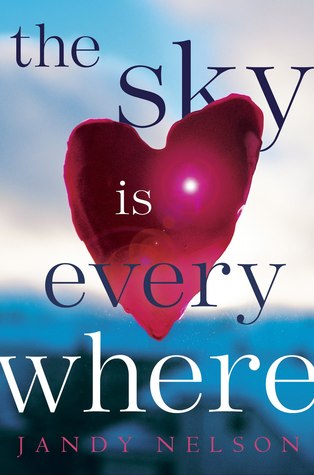
Recommended Book: The Sky Is Everywhere by Jandy Nelson

6604794-2
Hardcover, 288 pages Published March 9th 2010 by Dial Books


My Thoughts…
This book has been highly recommended to me over and over again because… well, Jandy Nelson.

If you’ve never read a Jandy Nelson book, you’re missing out on some of the most heartbreaking prose you’ll ever come in contact with. She has a way of making her characters breathe on the page in a way that will make you laugh and weep and then laugh again.

I’ve been fortunate enough to have never lost someone I’ve been very close to, but the raw vulnerability in Lenny’s grief will touch your heart. I also really believe it will help put words to your grief if you have lost someone close to you.

I 100% recommend this book!

Summary:

Seventeen-year-old Lennie Walker, bookworm and band geek, plays second clarinet and spends her time tucked safely and happily in the shadow of her fiery older sister, Bailey. But when Bailey dies abruptly, Lennie is catapulted to center stage of her own life – and, despite her nonexistent history with boys, suddenly finds herself struggling to balance two. Toby was Bailey’s boyfriend; his grief mirrors Lennie’s own. Joe is the new boy in town, a transplant from Paris whose nearly magical grin is matched only by his musical talent. For Lennie, they’re the sun and the moon; one boy takes her out of her sorrow, the other comforts her in it. But just like their celestial counterparts, they can’t collide without the whole wide world exploding.

Is There A “Writer Type”?

Sometimes I think I have a weird personality for a writer.

I’m not emotional enough.

Not artistic enough.

Not introverted enough.

Instead, I’m a Type-A personality. Driven. Focused. Blunt. Organized. Business minded.

I set goals quarterly and focus on the future and have professional goals outside of publishing.

Because of this, people often discount the creative in me. They are surprised that I write. They are surprised that I struggle with depression. They are surprised that I feel things on so many levels at the same time. Surprised that I internalize my emotions.

“Oh, I wouldn’t have guessed that about you,” is something I hear often.

And it’s been that way my entire life.

I used to think that writing was just what everyone’s go-to outlet was. That it was normal that I obsessively wrote in my journals as a teen. That it was normal I penned poems on scraps of paper and then threw them away in between class. That everyone needed to write out their emotions in some weird poem or story to understand what exactly they were feeling.

But I wasn’t a writer.

I was going to be a lawyer. A businesswoman. A politician.

I wasn’t creative enough to write.

And so that’s what I believed for years and years.

Until I grew so tired of telling myself I wasn’t a writer that it forced me to realize that being a writer was all I ever was.

So maybe I’m not the classic “writer type.”

Maybe I’m not traditionally creative and maybe marketing comes easier than beautiful prose.

But I’m still a writer.

I write to explore the world around me.

I write as an answer to the stereotypes that push against me.

I write to discover who I am outside of labels and categories and expectations and fears.

I write because that’s how I answer my own questions about faith and love and forgiveness and pain and bigotry and motherhood and so much more.

I write for me. I write for you.

I write.

write